
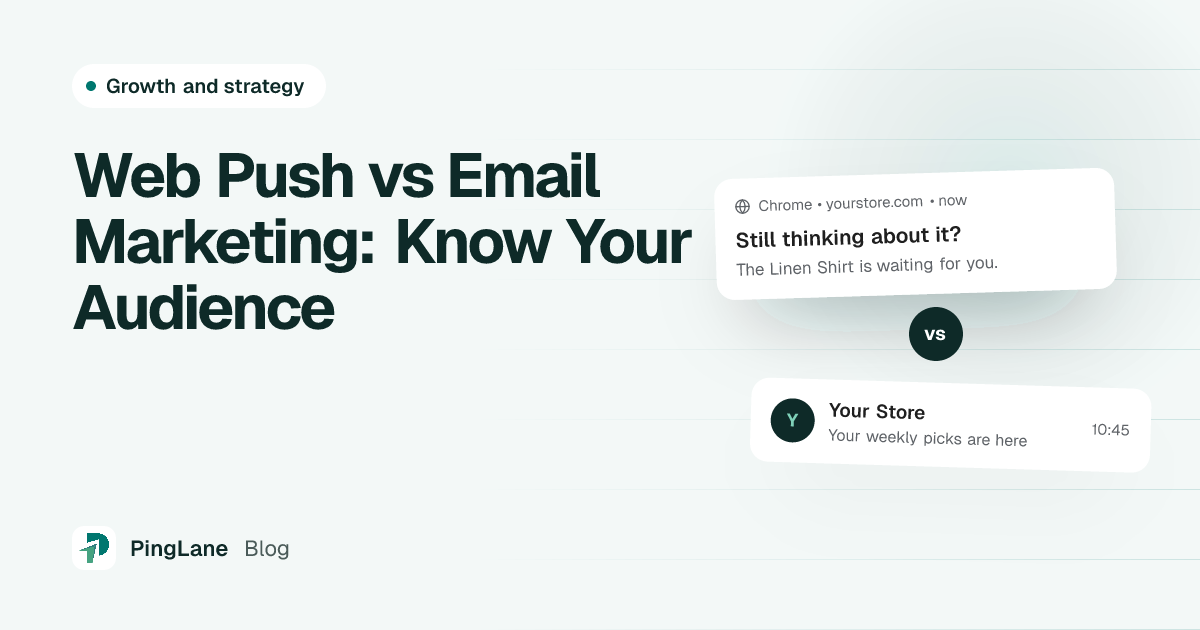
Most articles about push notifications vs email marketing turn it into a race. Who has better open rates? Who drives more clicks? Who wins?
That is the wrong way to look at it.
Push notifications and email marketing are not competing for the same job. They are built for two completely different groups of people. Once you understand that, you stop asking which one is better and start asking how to use both the right way.
The Real Question: Who Are You Actually Reaching?
Every person who visits your Shopify store belongs to one of two groups.
Group one: you know who they are. They signed up for your newsletter, made a purchase before, or filled out a form. You have their email address. You can use their name, group them by what they bought, and send a personal message to their inbox.
Group two: you do not know who they are. They visited your store, looked at a few products, maybe added something to their cart, and left. You have no email and no name. For most stores, this is by far the bigger group: most visitors never sign up for anything.
These two groups need different tools. This is where push notifications and email are different.
Email Marketing Is for Your Known Audience
When someone gives you their email address, they are telling you: “I trust you enough to let you into my inbox.” That is an important step, and it deserves a thoughtful reply.
Email is powerful because of what you know about the person. You can:
- Address them by first name
- Reference their past purchases
- Send a birthday discount
- Build a multi-email welcome flow
- Segment by what they bought, when they last purchased, or how much they spent
Email works best when the shopper already knows you. You can say a lot in one email, and a well-written email to someone who knows your brand can achieve a lot.
The limitation is simple. To send it, you need the email address. If the visitor never gave it to you, email cannot help you reach them.
Push Notifications Are for Your Anonymous Audience
Push notifications solve a completely different problem. They give you a way to reach visitors who never shared any contact information.
When a visitor opens your Shopify store and clicks “Allow” on your notification prompt, they become a push subscriber right away. No form. No email. Just one click. From that moment, you can send them messages directly to their browser, even after they have left your site.
This matters more than most store owners think. Think about all the people who visit your store each day. Most of them leave without buying. Most of them leave without signing up for anything. With email alone, they are gone forever. With push notifications, you can still reach them.
That is why push notifications are especially useful for:
Anonymous cart recovery. Someone added a product to their cart and left. You do not have their email. But if they are a push subscriber, you can still send them a reminder and bring them back.
Browse reminders. A visitor spent five minutes looking at a specific product and then left. A push notification at the right time, saying “Still thinking about it?”, can bring them back while they still remember the product.
Price drop alerts. A visitor opted in for a price alert on a product. The moment the price drops, they get a notification right away without you needing to know who they are.
With PingLane, all of these automations run in the background without any manual work. A visitor subscribes, does something on your store, and the right message goes out at the right time.
They Work Better Together
Here is something important. The visitor who subscribed to your push notifications today might give you their email tomorrow. The customer who has been on your email list for a year might also be a push subscriber.
Many successful Shopify stores do not choose between push and email. They use both, and they use each one for what it is good at.
A practical way to think about it:
- New anonymous visitor subscribes to push and browses your store. Push handles the follow-up: browse reminder, cart recovery, welcome series.
- Same visitor makes a purchase and gives you their email at checkout. Now email takes over: order confirmation, post-purchase follow-up, loyalty offers.
- You run a sale and want to reach everyone. Send a push campaign to your subscribers and an email campaign to your list at the same time.
Each channel reaches people the other one cannot. Together, they help you lose fewer shoppers.
Frequently Asked Questions
Can I use push notifications without having an email list?
Yes. Push notifications work independently. You do not need an email list to start collecting push subscribers and sending automated notifications on Shopify.
Do push notifications and email reach the same subscribers?
Sometimes, but usually not. A push subscriber only opted into notifications, not emails. An email subscriber only gave you their email. There is often very little overlap, which is why using both expands your total reach.
Which one should I set up first as a new Shopify store?
Start with push notifications. They work for every visitor, including anonymous ones, from day one. Email becomes more useful once you have a good-sized list.
Is it annoying to send both push and email to the same person?
Not if you use them for different things. Use push for quick, time-sensitive messages like cart reminders. Use email for longer messages that build the relationship, like product recommendations or loyalty rewards.
Use the Right Tool for the Right Person
Push notifications and email are not fighting for the same audience. They are reaching two different groups of people, and doing it in two different ways.
Email reaches the people who already trust you. Push notifications reach the people you have not met yet. Both groups matter. Both deserve to be reached.
If your Shopify store only uses email, you cannot reach most of your visitors. Add push notifications with PingLane and start turning anonymous visitors into returning customers.